
-
 Australia
-
 Austria
-
 Belgium
-
 Brazil
-
 Canada
-
 China
China
-
 Czech Republic
-
 Denmark
-
 Finland
-
 France
-
 Germany
-
 Greece
-
 Hong Kong
-
 Hungary
-
 Iceland
-
 India
India
-
 Ireland
-
 Israel
-
 Italy
Italy
-
 Japan
Japan
-
 Korea
Korea
-
 Luxembourg
-
 Malaysia
-
 Netherlands
-
 New Zealand
-
 Norway
-
 Poland
-
 Qatar
Qatar
-
 Romania
-
 Saudi Arabia
-
 Singapore
-
 Spain
Spain
-
 Sweden
-
 Switzerland
-
 Taiwan
-
 Turkey
-
 United Kingdom
-
 United States
research use only
Scoparone
Cat.No.S3613
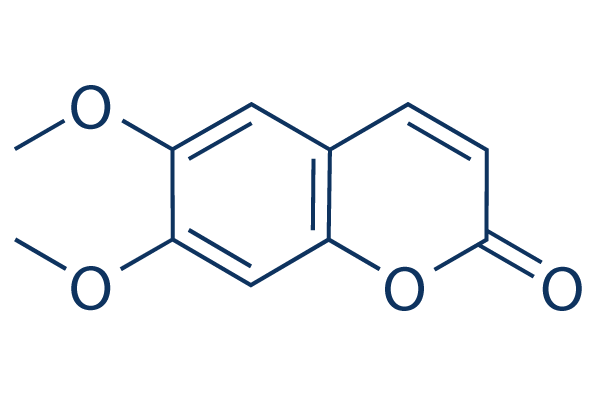
Chemical Structure
Molecular Weight: 206.19
Quality Control
Solubility
|
In vitro |
DMSO
: 41 mg/mL
(198.84 mM)
Ethanol : 41 mg/mL Water : Insoluble |
Molarity Calculator
|
In vivo |
|||||
In vivo Formulation Calculator (Clear solution)
Step 1: Enter information below (Recommended: An additional animal making an allowance for loss during the experiment)
Step 2: Enter the in vivo formulation (This is only the calculator, not formulation. Please contact us first if there is no in vivo formulation at the solubility Section.)
Calculation results:
Working concentration: mg/ml;
Method for preparing DMSO master liquid: mg drug pre-dissolved in μL DMSO ( Master liquid concentration mg/mL, Please contact us first if the concentration exceeds the DMSO solubility of the batch of drug. )
Method for preparing in vivo formulation: Take μL DMSO master liquid, next addμL PEG300, mix and clarify, next addμL Tween 80, mix and clarify, next add μL ddH2O, mix and clarify.
Method for preparing in vivo formulation: Take μL DMSO master liquid, next add μL Corn oil, mix and clarify.
Note: 1. Please make sure the liquid is clear before adding the next solvent.
2. Be sure to add the solvent(s) in order. You must ensure that the solution obtained, in the previous addition, is a clear solution before proceeding to add the next solvent. Physical methods such
as vortex, ultrasound or hot water bath can be used to aid dissolving.
Chemical Information, Storage & Stability
| Molecular Weight | 206.19 | Formula | C11H10O4 |
Storage (From the date of receipt) | |
|---|---|---|---|---|---|
| CAS No. | 120-08-1 | Download SDF | Storage of Stock Solutions |
|
|
| Synonyms | 6,7-dimethoxycoumarin, Aesculetin dimethyl ether, 6,7-Dimethylesculetin, Escoparone | Smiles | COC1=C(C=C2C(=C1)C=CC(=O)O2)OC | ||
Mechanism of Action
| In vitro |
The proliferation of VSMCs is significantly attenuated by scoparone in a dose-dependent manner. Scoparone markedly reduces the serum-stimulated accumulation of cells in the S phase and concomitantly increases the proportion of cells in the G0/G1 phase, which is consistent with the reduced expression of cyclin D1, phosphorylated Rb and survivin in the VSMCs. Cell adhesion markers, such as MCP-1 and ICAM-1, are significantly reduced by scoparone. It attenuates the increase in cyclin D promoter activity by inhibiting the activities of both the WT and active forms of STAT3. scoparone blocks the accumulation of STAT3 transported from the cytosol to the nucleus, leading to the suppression of VSMC proliferation through G1 phase arrest and the inhibition of Rb phosphorylation. This activity occurs independent of the form of STAT3 and upstream of kinases, such as Jak and Src, which are correlated with abnormal vascular remodeling due to the presence of an excess of growth factors following vascular injury. The protective effect of scoparone involves anti-inflammatory functions that occur via the inhibition of NF-κB activity, leading to the downregulation of pro-inflammatory cytokines and chemokines, such as tumor necrosis factor (TNF)-α, interleukin (IL)-6, IL-8 and monocyte chemoattractant protein (MCP)-1.
|
|---|---|
| In vivo |
The free radical scavenging property of scoparone leads to the attenuation of intima thickening and improves hemodynamics in cholesterol-fed alloxan-diabetic rabbits concurrent with decreases in plasma lipid and lipoprotein cholesterol concentrations. Scoparone exhibited therapeutic efficacies on liver damage in vivo.
|
References |
|
Tech Support
Tel: +1-832-582-8158 Ext:3
If you have any other enquiries, please leave a message.

Products are for research use only. Not for human use. We do not sell to patients.
©Copyright 2013 Selleck Chemicals. All Rights Reserved.